Uruguay country information
immigration, regulations on farmland property purchase, real estate taxes
facts for farmland investments, potential for agriculture
(Oct 2017)


 farmland listings & news feed
 offers farmland Paraguay
 offers farmland Uruguay
Cerro Cora 1124
CP1544 Asuncion, Paraguay
Paraguay mobile
+595-984-875 014
farmland realtor
since 1997
 real estate Uruguay
  Immobilien Uruguay
Uruguay is one of the easier countries to obtain legal residency (residencia legal permanente). Please view the separate page immigration Uruguay
regulations of farmland property purchase
- foreigners : no restrictions apply. Foreigners, resident and non-resident, are treated the same as nationals and can purchase any lands of any size anywhere
- companies, as opposed to individuals, can buy farmland, too, but must register by name all their shareholders. Companies, which by nature, like pension funds, publically traded companies, can not name all their shareholders, can therefore usually not buy. In some prominent cases exceptional permit has been granted if deemed in national interest.
Property transactions costs
- buyer’s commission : 3% +VAT, negotiable with large transactions
- notary costs are somewhat high since contribution to national chamber of notaries and VAT alone amounts to 1% of sales price. Total notary fees should be 2 – 3,5% (VAT included) depending whether size of transaction allows for some negotiation of fees
- taxes and stamp fees amount to an additional 1%
- purchases of lands larger then 500 hectare involve another 2% of taxes
Taxes, capital transfer
- Uruguay taxes income (it was only introduced a few years ago), nationals on their world income, foreign legal residents on their territorial income (therefore excluding offshore income) rates naturally vary, 20% as rough figure might give an idea.
- Farming income is equally income taxed. However, medium size farmers, nationals and foreign legal residents, can opt for a low VAT on agri products (IMEBA), replacing income tax
- Tax on wealth is levied, but farmland is exempted
- Property tax on farmland, including social security contribution, is rather low. To serve as an example : 200 hectare land, Coneat 100, might pay roughly US$2400 anually
- Import duties are rather high, making some imported goods rather expensive, VAT : 22%
- Capital transfer, in & out of the country is unrestricted
- Uruguay has a general banking secret, however, globally (as of 2015) the tendency is clearly not in favour of banking secrets
some geographic data
more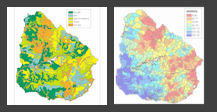 uruguay soil maps
more
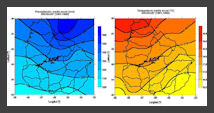 uruguay climate/rainfall maps
Uruguay climate, soils and topography
Uruguay is situated entirely in the humid subtropics, with 1200-1400mm annual rainfall, statistically evenly distributed throughout the year, though in reality droughts do occur. It is however the most benign climate belt for both agriculture and livestock
The land is in most parts gently undulating with smaller streams never being far away ( and ground water at 10–50m depth ).
Soils are mostly of the dark brown to black color type, of medium depth, favourable soil properties and medium high nutrient content (generally with P deficiency)
The two maps below serve well to indicate Uruguay’s agri pontial in global comparison because they take all major factors into account.
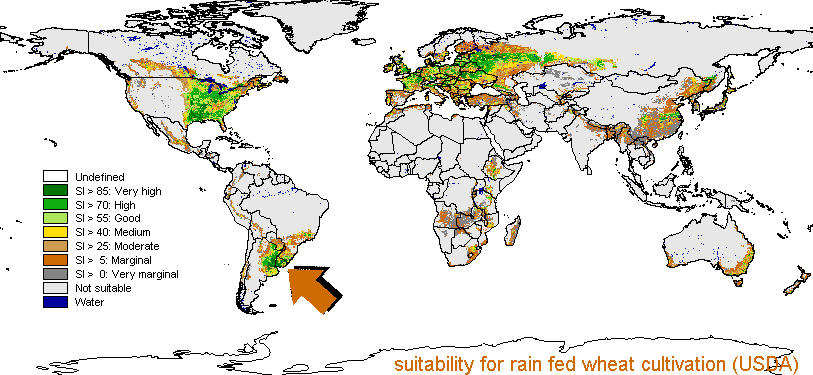
map suitability wheat cultivation, rain fed
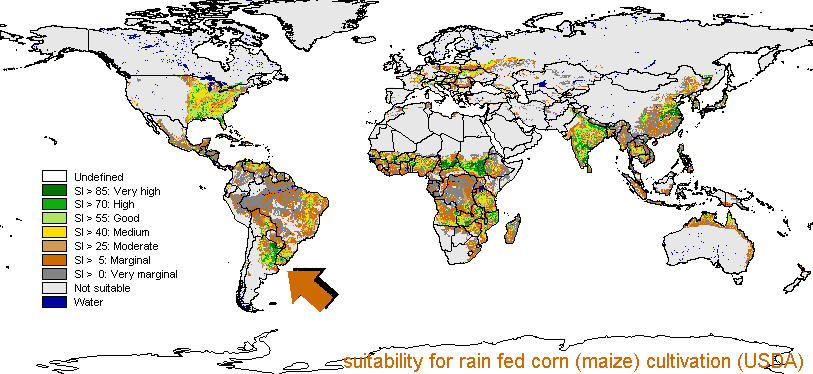
map suitability corn cultivation, rain fed
.
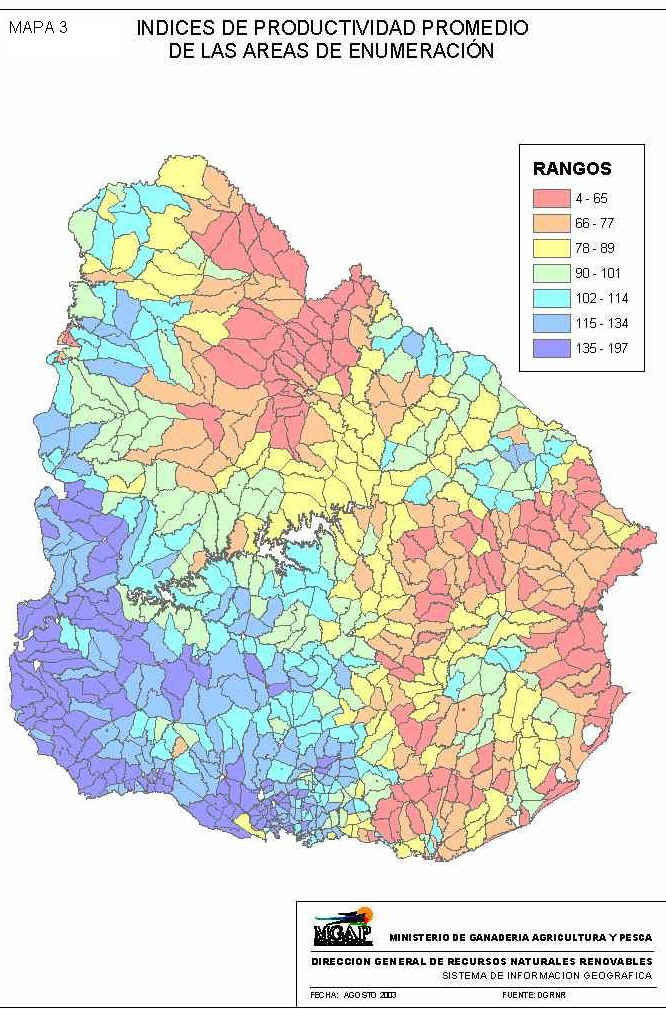
The most fertile soils are found in Uruguay's western/southwestern fringe.
The Uruguay soil fertility map below is based on Uruguay's Coneat soil productivity classification system, ranging from dark blue (high fertility) to red (poor fertility)
for detailed scientific description of each soil type follow links below :
 soils type 0
soils type 1+2
soils type 3+4+5
soils type 6+7
soils type 8+9
soils type 10
soils type 11+12+13
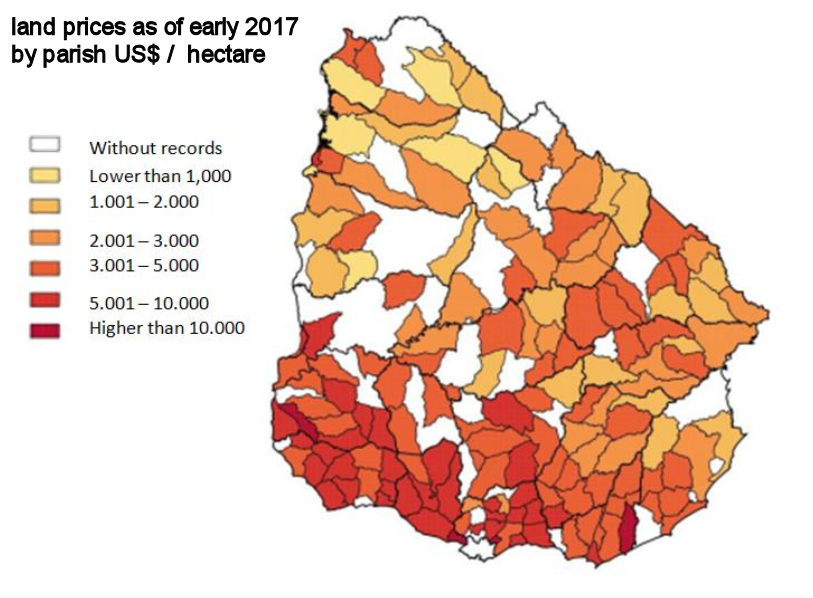
prices for farmland paid in the first half of 2017, USD per hectare (2,47 acre)
Germany's Lateinamerika Verein's December 2014 country report on Uruguay states that Uruguay with its 3 million people can feed 28 million people. That should be the best such ratio (population to food production potential) in the entire world, a world that has seen the ratio arable land per capita halve to 0,2 hectare over the last decades.
Uruguay's climate does not vary significantly regionally, shown below :anual rainfall and mean temperature
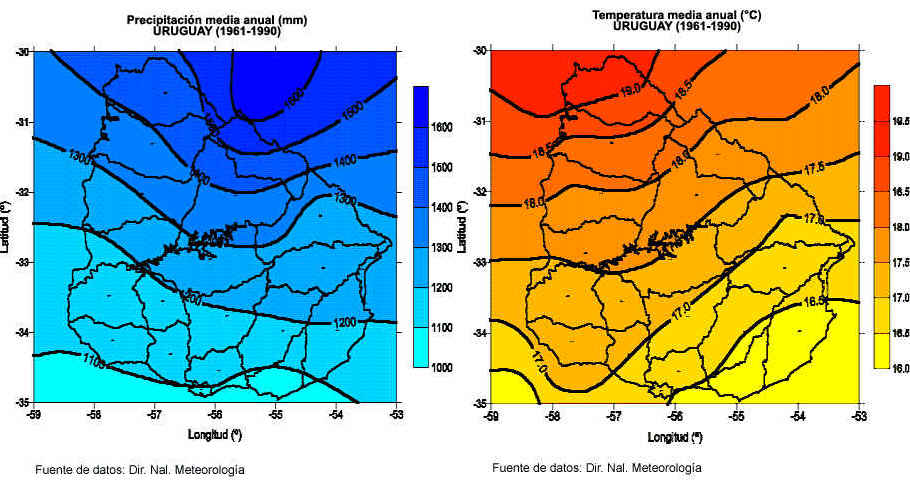
Global climate change effects on Uruguay
Projections mostly predict a milder temperature increase compared to other world regions, and slightly increasing annual rainfalls, so that the precipitation - evaporation balance of soil humidity should remain roughly unchanged, with slightly increased vegetation periods and hence slightly rising yields for crops like soya and corn (maize). Rainfalls may on the other hand become more erratic, causing damage through droughts and run off. In total, the balance of effects for the next 40-50 years should be roughly neutral.
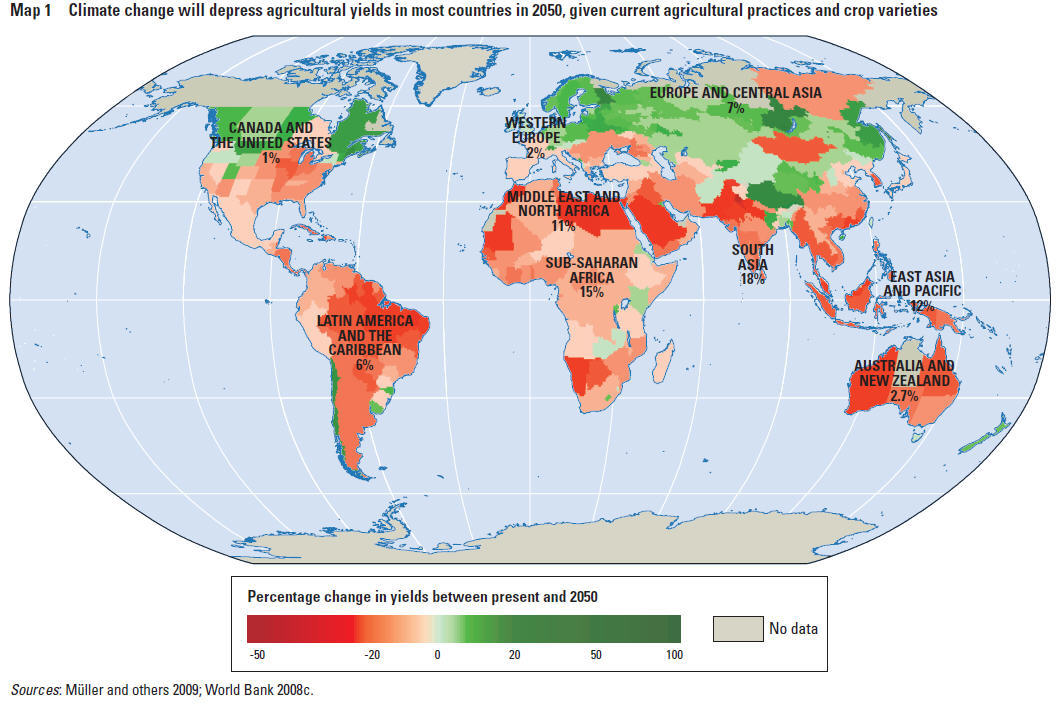
This 2010 World Bank publication map on estimated effects on yields in 2050 mainly confirms that high latitude regions will gain and most others will loose. The map has its shortcomings, it does not differentiate within such climatically diverse countries as Argentina or Chile which will have their distinct gaining and loosing regions, but confirms the rather benign outlook for Uruguay.
.
some Uruguay economic data
.
GDP $58.4 billion (2017 est.)
GDP - per capita: $22,400 (2017 est.)
GDP - composition, by end use:
household consumption: 65.3%
government consumption: 14.1%
investment in fixed capital: 18.6%
investment in inventories: -0.2%
exports of goods and services: 22.3%
imports of goods and services: -20.1%
(2013 est.)
GDP - composition, by sector of origin:
agriculture: 6.2%
industry: 25.5%
services: 68,3
Unemployment rate: 7.3% (2013 est.)
Distribution of family income - Gini index: 45.3
Taxes and other revenues: 29,3% of GDP (2017 est.)
Budget deficit (-):-3.7% of GDP (2017 est.)
Public debt: 66.2% of GDP (2017 est.)
Inflation rate (consumer prices): 6.2% (2017 est.)
Central bank discount rate: 9% (31 December 2017)
Commercial bank prime lending rate: 13.6% (31 December 2017 est.)
Current account balance: 955 million (2017 est.)
agri export sector
Break up of Uruguay’s export earnings by agri commodity type. Weaker global prices of grains and soya will take their toll on export earnings in 2015, estimates shown below. Reduced earnings in grains and soya will be partly offset by an estimated US$500m earnings increase in pulp, with at least one giant paper mill coming into production
agri commodity type exported
2014 metric tons(t)
2014 average price USD/t
2014 export earnings x1000USD
2015 metric tons(t) estimate
2015 average price estimate USD/t
2015 export earnings estimate x1000USD
wheat
1.445.000
297
330.000
900.000
209
189.000
soya
3.177.000
508
1.651.000
3.400.000
370
1.035.000
dairy (milk powder etc)
810.000
565.000
beef
1.863.000
1.844.000
rice
506.000
452.000
.
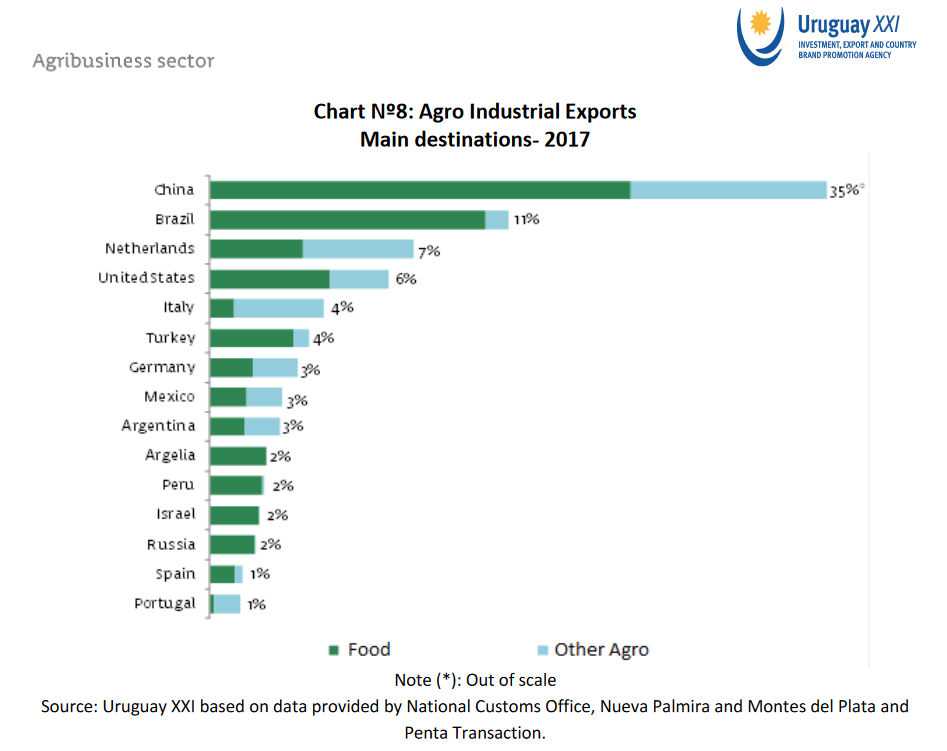
Uruguay Agri Export main destinations 2017
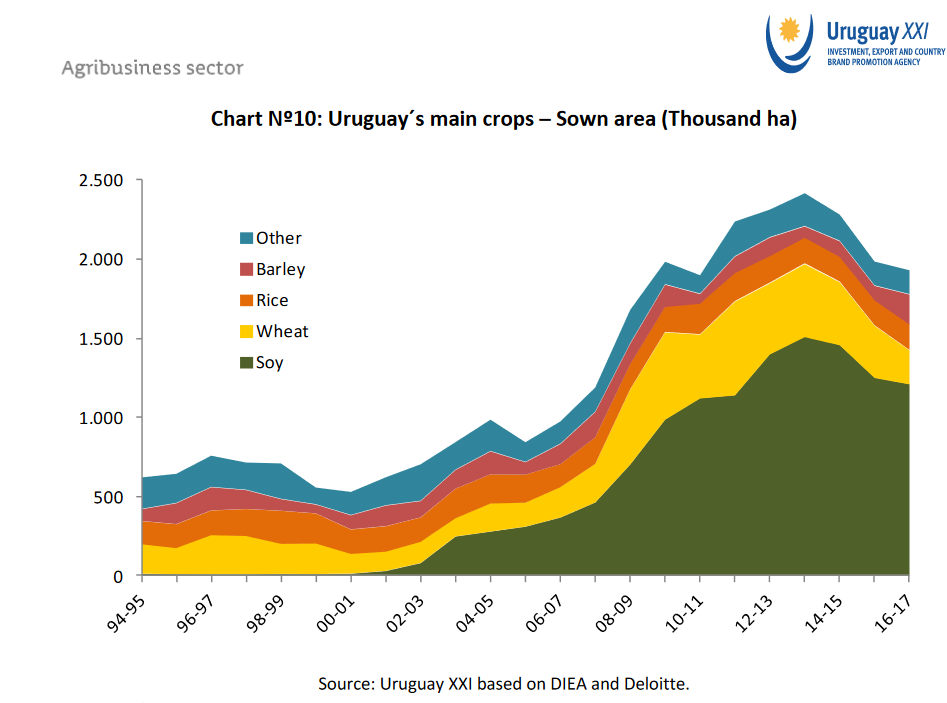
Uruguay main crops, break up and expansion 1995 to 2017
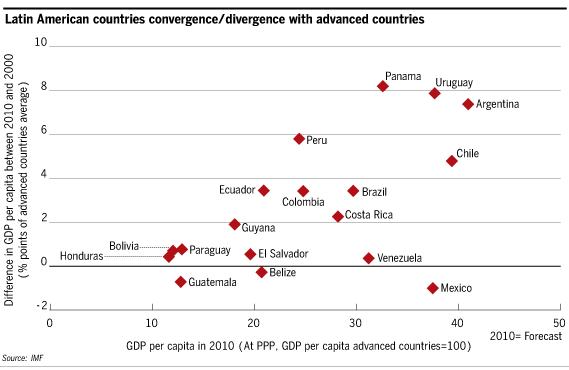
though some years old, this graph still gives a first glance idea where Uruguay stands within Latin America
political risk perception
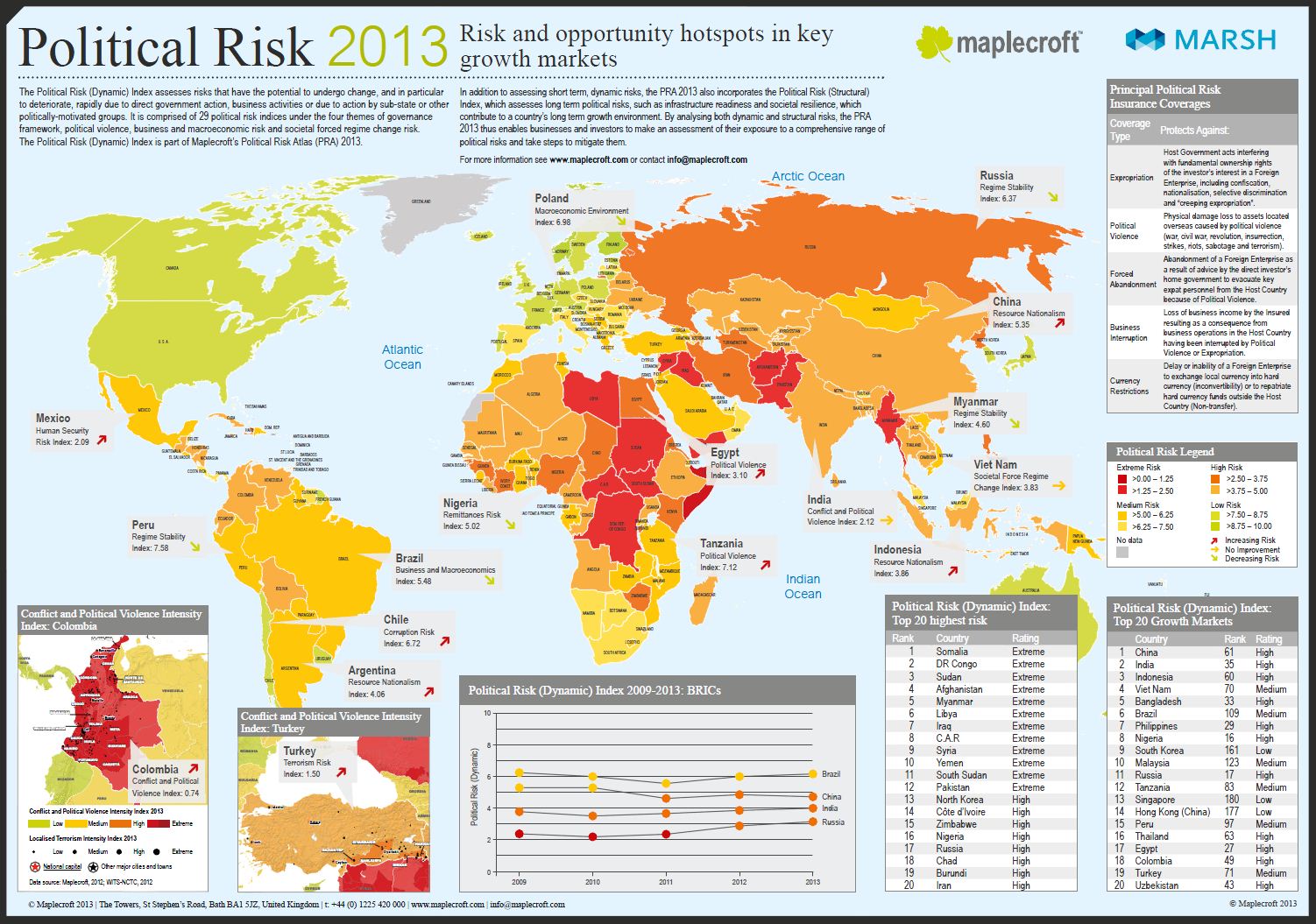
Marsh & Maplecroft, the economics intelligence providers, rate Uruguay as "Low Risk" as political country risk for foreign investors, for 2013 and again 2014. Of all countries of the Americas, it is a rating they only apply to the US, Canada, Chile and Uruguay.
above mentioned characteristics compare favourably to taxes, regulations in Argentina (in farmland investments news)
- Diesel fuel per litre : US$ 1,35
- farm worker monthly labour cost all in : US$1000
- grain prices : differing little (+/- 0-10%) from US and global prices
- life cattle / steers : US$1,70/kg
cattle/beef in Uruguay, numbers for the year ending June 2017
- size of Uruguay's national herd: 11,7 million head
- mortality, long term average : 2,5%
- slaughtered : 2,3 million head
- life cattle exported : 0,3 million
- beef exported : 445.000t at avarage US$3400/t, equalling US$1,5bn
Uruguay commodity prices, Mar 20-30.2018
grain prices : ex port Nueva Palmira or Montevideo, slaughter cattle : put in plant
- wheat US$/ton $190
- maize US$/ton $210
- soya US$/ton $350
- slaughter cattle, steers US$/kg life weight $1,70
- slaughter cattle, cows US$/kg life weight $1,50
- calves 150 kg US$/kg $2,00
(sources : www.camaramercantil.com.uy, www.acg.com.uy)